
They go by many names—Personal Shopper, Shopping Guide, or AI Shopping Assistant. Operating across e-commerce sites, WhatsApp, in-store kiosks, or phone calls, these agents step in to guide purchase decisions. Soon, they will also need to interface directly with the customer’s personal agent. But long before worrying about in-chat payments, a more fundamental question arises: how can an agent genuinely help customers decide—without frustrating them, burning through unnecessary tokens, or eroding profit margins?
That’s where the trap lies.
Building a customer support agent can seem relatively straightforward: user intent is often deterministic—“Where is my order?”, “Can I return this item?”. But a Shopping Agent can’t just spit back a list of products. A customer who knows exactly what they want has completely different needs than one who is browsing, comparing, or looking for guidance.
The real question is: what level of sales intelligence should you deploy against which customer friction—and backed by which capabilities to make it genuinely useful?
The 4 Shopping Agent Framework
Not all Shopping Agents address the same friction point. We have identified four archetypes of sales intelligence, each serving a distinct purchasing logic.
The Matrix: 2 Key Dimensions
To better understand why Shopping Agents can exhibit such different behaviors, we examine the buying process across two fundamental dimensions.
Reliance on Expertise
This dimension measures the level of knowledge required to help the customer make an informed choice: technical specifications, compatibility, usage constraints, or diagnostics.
Nature of Purchase
The purchase motivation can rest primarily on objective criteria—price, dimensions, power, performance—or on more subjective criteria—style, aesthetics, preferences, or aspirations.
The intersection of these two dimensions reveals four Shopping Agent archetypes, each catering to distinct intelligence requirements. Their relevance ultimately hinges on the product category, the customer journey, and the specific retail friction being solved:
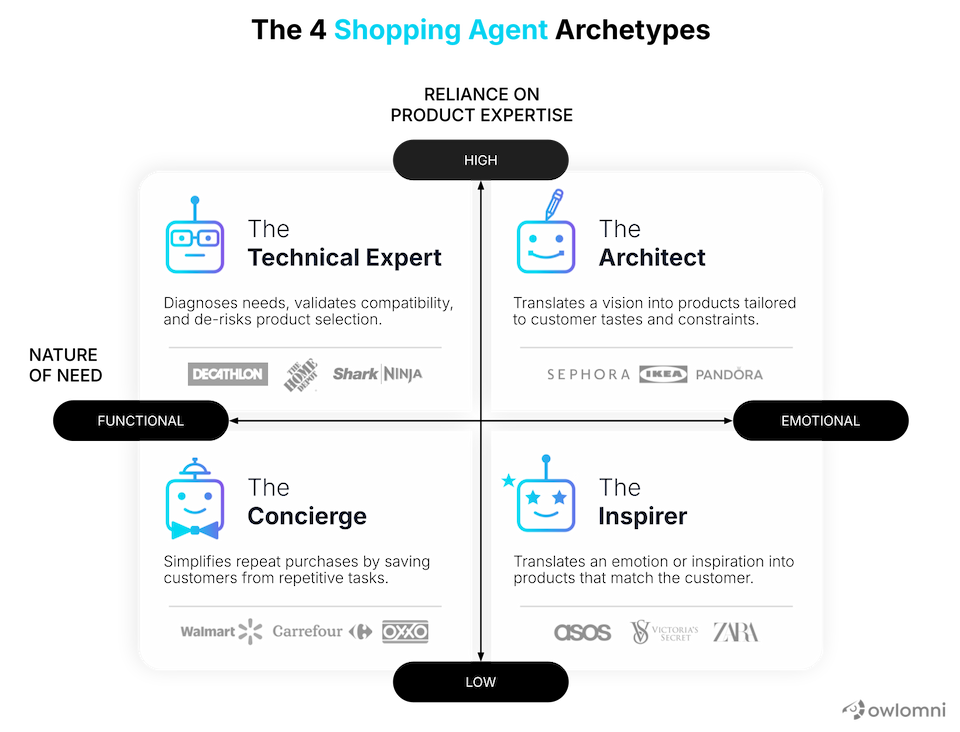
This framework applies equally to vertically integrated brands—like SharkNinja, IKEA, or Pandora—and to multi-brand retailers or major distributors—such as Amazon, Sephora, or Boulanger. All must grant the agent access to core purchasing data and services: product details, pricing, inventory availability, business rules, and even transaction execution. Yet this foundational layer alone doesn’t define the agent’s value. Depending on the product, context, and decision at hand, the required intelligence varies dramatically.
These four archetypes are neither rigid personas nor isolated silos; they represent core competencies that can be combined and expanded based on the business objective. For instance, Sephora might act as an Architect when building a personalized skincare routine, then shift to a Concierge when a customer simply wants to reorder their go-to perfume or foundation.
The goal is not to pick a single archetype, but to determine which competencies to prioritize, for which use cases, and backed by which underlying capabilities.
The Technical Expert

- Translate complex customer problems into precise product recommendations.
- Rigorously verify technical compatibility across different components.
- Deeply compare technical specifications and features across multiple SKUs.
The Architect

- Translate a vision or concept into an actionable shopping list.
- Build solutions under multiple constraints: budget, preferences, compatibility, dimensions, usage…
- Retain relevant context to evolve and refine the solution over time.
The Concierge

- Execute transactional and routine tasks (search, filter, zero-click add-to-cart).
- Automatically find and apply optimal discounts or loyalty rewards.
- Anticipate fulfillment needs based on purchase history and reorder frequency.
The Inspirer

- Translate subjective feelings, vibes, or aesthetics into concrete product attributes.
- Leverage visual inputs (photos, mood boards) to run similarity searches.
- Recommend items through style, color, or shape matching beyond basic functional features.
Tomorrow: Interfacing with Your Customer’s Agent
These four commercial intelligence archetypes won’t stay confined to your own touchpoints (website, in-store kiosk, or WhatsApp). The stakes are much higher: as consumers delegate product research and comparison to their personal AI assistants, your decision-support engine must be accessible externally. That is why defining your agent strategy today is so critical.
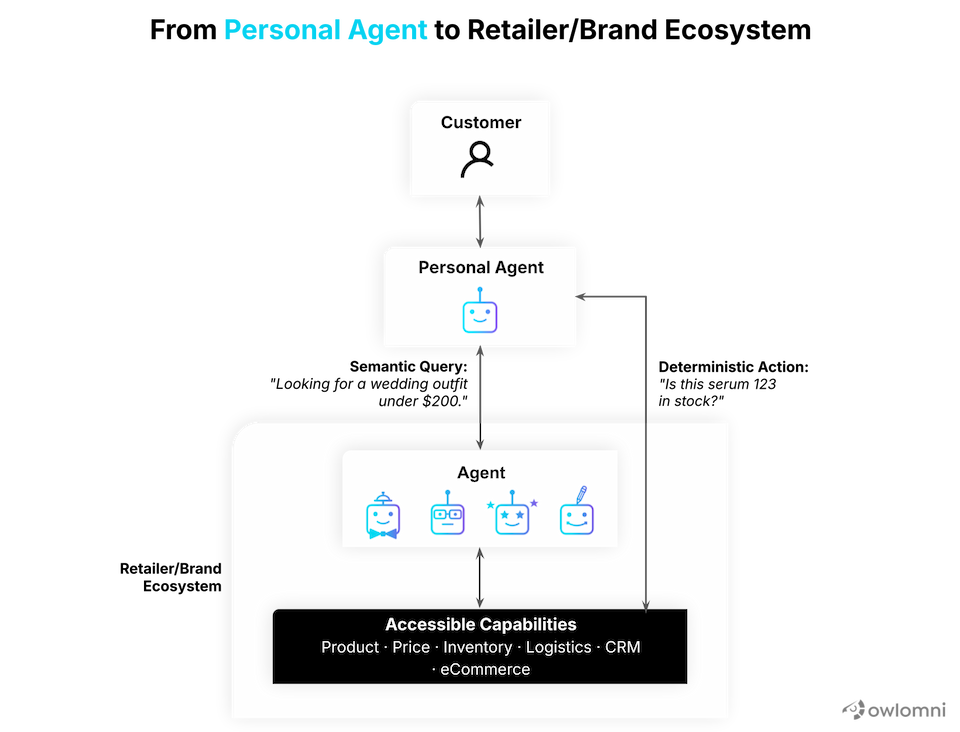
For mechanical requests from a third-party agent, exposing raw data (pricing, inventory) via API is enough. But whenever the goal is guiding a choice, handling complex constraints, or co-creating a tailored solution, data alone is blind.
To keep influencing the buying decision—whether the customer browses your site directly or tasks their own personal agent—opening up your catalog won’t suffice. You must expose and back it with specialized commercial intelligence.
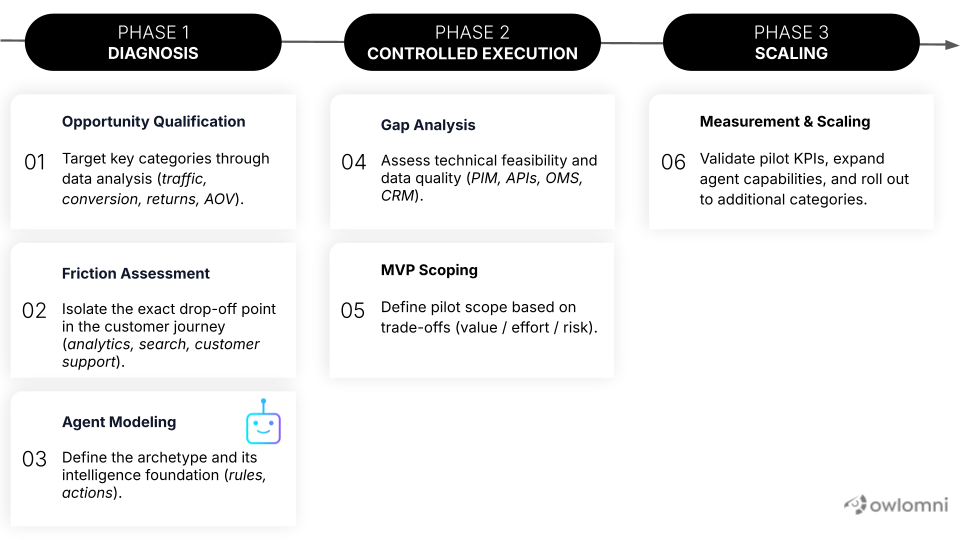
From Theory to Practice: 6 Steps
The four archetypes aren’t options a retailer chooses based on intuition. You don’t simply decide to become an Expert, an Architect, a Concierge, or an Inspirer—it is a business value trade-off.
The approach shouldn’t start with technology, but with value potential. The goal is to immediately identify product categories where friction is most costly and conversion potential is highest. This avoids a classic trap: committing to a six-month initiative to clean and structure the entire catalog before even testing the agent.
By starting with a focused, strategic scope, retailers can demonstrate the agent’s value, build the necessary underlying capabilities, and progressively prepare for scaling.
We break this process down into 6 steps, from value opportunity to measuring impact:
Framework Illustration with a Fictional Use Case: High-End Skincare
Part 2: Our Study of 40 Retail Players
Between market hype and ground reality, where do brands actually stand?
In the second part of this study, we put our framework to the test by evaluating 40 global retailers across 11 operational scenarios. The results reveal a massive gap: while the vast majority of Shopping Agents remain stuck as glorified search engines, a handful of pioneers are already shaping the future of retail sales.